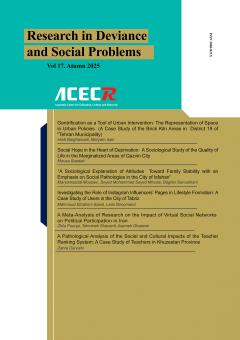
Gentrification as a Tool of Urban Intervention: Representations of space in Urban Policies (A Case Study of Brick Kilns in Tehran Municipality District 19)
Subject Areas : urban Issues and marginalization
Hadi Barghamadi
1
 ,
Maryam Isari
2
*
,
Maryam Isari
2
*
1 - Assistant Professor, Institute for Humanities and Social Studies in ACECR, Tehran, Iran.
2 - Assistant Professor, Deprtment of Family Studies, Institute for Humanities and Social Studies in ACECR, Tehran, Iran.
Keywords: Gentrification, Brick Kilns, Informal Settlements, Representations of Space, Tehran Municipality District 19.,
Abstract :
Gentrification as a Tool of Urban Intervention: The Representation of Space in Urban Policies
(A Case Study of the Brick Kiln Areas in
District 19 of Tehran Municipality)
Hadi Barghamadi*
Maryam Isari**
This article analyzes the discourse of gentrification in Sub-district 3 of District 19 of Tehran Municipality, focusing specifically on brick kilns and their surrounding informal settlements. The core argument is that urban intervention policies in this zone are framed not to enhance the quality of life or address social needs, but rather within a dominant discourse of "organization," "upgrading," "renewal," and "clearance." By representing urban space as a site of "pathology," "threat," and "defenseless space," and by ignoring the structural causes of poverty, this discourse rationalizes interventions that culminate in gentrification, inflated land values, the displacement of subaltern populations, and the eradication of informal settlements. Adopting a mixed-methods approach, this study utilizes a complete census survey of kiln residents, semi-structured interviews with key informants, and an analysis of urban planning documents. The findings reveal a profound chasm between the official narrative of the kilns and the lived experiences of their inhabitants. While urban management represents kiln residents as social pathologies and the "undeserving poor," field data demonstrate that inhabitation in this area stems from chronic poverty, restricted access to formal housing, and a lack of institutional support. The study concludes that regeneration and redevelopment projects in Sub-district 3 are primarily designed to release land, accommodate new demographics, and escalate land value, thereby inducing forced displacement and residential instability. The fundamental issue is the pathologized construction of space within official discourse a discourse that reduces urban problem-solving to physical clearance and spatial commodification while obfuscating the structural mechanisms of marginalization.
Keywords: Gentrification, Brick Kilns, Informal Settlements, Representations of Space, Tehran Municipality District 19.
Introduction
Over recent decades, urban interventions in fabrics designated as deteriorated areas, informal settlements, hazardous lands, and inefficient urban spaces have become a cornerstone of urban policymaking in Iran. These interventions are typically justified under the guise of reorganization, renewal, urban regeneration, environmental quality enhancement, and the mitigation of social anomalies. However, the experience of numerous cities demonstrates that such policies predominantly adopt a rigid physical-spatial approach, lacking sufficient commitment to the social dimensions and justice-oriented aspects of urban development. Consequently, rather than improving the living conditions of incumbent residents, many urban renewal and regeneration programs have triggered skyrocketing land values, eradicated affordable housing, exacerbated spatial and social inequalities, and ultimately catalyzed gentrification and the forced displacement of low-income populations.
A pivotal element in this process is how space and its residents are represented within the official discourse of urban management. In most instances, spaces such as informal settlements and brick kilns are represented not as vital locales for the residence and livelihood of citizens, but as "hubs of pathology," "threats," "defenseless spaces," "social hazards," or "barriers to development." Such representations do more than just define the problem; they predetermine the preferred mode of intervention, thereby legitimizing policies where physical clearance, land appreciation, and shifting the social composition of residents are framed as self-evident and indispensable solutions.
Focusing on Sub-district 3 of District 19 of Tehran Municipality, this study investigates the representation of informal spaces and its relationship with urban organization and regeneration policies. This zone, encompassing the neighborhoods of Northern Dowlatkhah, Southern Dowlatkhah, and Esmailabad, has emerged as a primary arena for urban intervention due to its decommissioned brick kilns, informal settlements, dense population of Afghan migrants, informal economic activities, and concentrated social vulnerabilities. The central research question interrogates how the official representation of Sub-district 3 and its brick kilns as a "pathologized space" and an "inefficient zone" paves the way for policies that ultimately induce gentrification, coercive renewal, and the displacement of marginalized residents.
Methodology
This study adopts a mixed-methods research design. Data collection incorporated quantitative tools (a survey) alongside qualitative methods (documentary research, secondary analysis, interviews, and field observations). The empirical field comprises three out of the five neighborhoods within Sub-district 3 of District 19 of Tehran Municipality. In the quantitative phase, a complete census was conducted across all brick kilns in the three selected neighborhoods to gather comprehensive socio-economic data on the resident households. In the qualitative phase, the study utilized urban planning document analysis, secondary data analysis, and semi-structured interviews with urban managers, experts, kiln owners, local informants, and informal settlement residents.
Findings
The findings indicate that the brick kilns in Sub-district 3 of District 19 possess a long history in Tehran. These kilns emerged during the 1950s following the relocation of brick-making industries from other parts of the capital to the Dowlatkhah area. From the 1950s through the 1970s, they supplied a substantial portion of the bricks required for Tehran's rapid urbanization. Residential settlements gradually formed around these kilns to house workers, which subsequently evolved into the current residential fabrics. With industrial modernization, the depletion of viable clay reserves, tightening environmental regulations, and the enactment of laws mandating the relocation of polluting industries beyond a 120-kilometer radius from metropolitan centers, the kilns were decommissioned, leaving vast tracts of land vacant and abandoned.
In recent years, these vacant lands have garnered significant attention from urban authorities as prime sites for spatial intervention. The "Sub-district 3 Organization Plan of District 19 of Tehran Municipality," widely known as the Sub-district 3 Regeneration Plan, stands as one of the most critical urban governance policies aimed at converting lands adjacent to the kilns and managing the area’s informal settlements. Furthermore, the Comprehensive Joint Action Plan for Resolving the Issues of Sub-district 3 of District 19 mandates kiln owners to clarify the urban planning status of their properties and terminates lease contracts for informal shacks as approved strategic directives. The regeneration plan for these abandoned lands and former kiln expansion areas officially pursues goals such as housing provision, enhancing environmental quality and local identity, improving spatial cohesion, and fostering comprehensive economic, social, and environmental development.
However, the results of this study demonstrate that from the perspective of urban managers, the brick kiln lands are paradoxically framed: they are viewed simultaneously as a lucrative development opportunity and a resource for metropolitan housing provision, and conversely, as a severe threat that fosters and perpetuates social pathologies.
Data from the census conducted in March 2023 reveal that a total of 353 individuals, comprising 96 households, reside in the settlements surrounding the brick kilns. A significant majority of this population consists of Afghan migrants, with a median resident age of approximately 28 years. Nearly half of the population is illiterate, and the vast majority are underemployed in low-income, precarious jobs such as manual labor, or are entirely unemployed. The average length of residence for household heads in Tehran exceeds 20 years, and their average duration of residence in their current location is about 8 years, indicating a deeply entrenched, long-term presence in the city.
The housing conditions of these households are severely substandard. The average dwelling size is a mere 19 square meters, with most families crammed into highly congested units. Approximately 86% lack private sanitation facilities, and over half do not have separate kitchens. Nearly all households are deprived of municipal water connectivity and individual water meters, and a large majority lack access to the urban gas network. The most acute grievances voiced by residents include the absence of private toilets, the lack of water heaters, exorbitant electricity costs, and the daily struggle to secure basic survival needs. These empirical metrics demonstrate that despite their long-term urban residency, kiln inhabitants subsist in highly precarious conditions, completely disenfranchised from basic urban infrastructure.
In sharp contrast, an analysis of the dominant official discourse governing urban policymaking reveals those municipal managers and experts heavily pathologize the area. Many official interviewees depicted the abandoned kilns as havens for drug users, the homeless, undocumented migrants, and other vulnerable groups. From their viewpoint, vacant lands and defenseless urban spaces are the primary catalysts sustaining social anomalies. Within this official narrative, land organization and development projects are marketed as objective solutions to mitigate social harm, bolster security, and improve environmental quality.
Beyond pathologizing the space, the official representation of the residents themselves is deeply negative. In administrative rhetoric, Afghan migrants and informal settlers are framed not merely as marginalized or underprivileged groups, but as active vectors of pathology and core components of the region's social crisis. Certain narratives directly link the dense presence of Afghan nationals to rising social harms, public health hazards, and strain on urban infrastructure. This mode of representation deliberately diverts attention away from the structural roots of poverty, housing market exclusions, systematic deprivation, and social discrimination, choosing instead to blame the residents as the primary source of local crises.
In this context, this study uncovers a profound disconnect between the official narrative and the lived realities of the residents. While urban managers portray kiln residents as "undeserving individuals" who choose to live there due to cheap rent, access to charity, and a preference for a low-cost lifestyle, the residents' narratives present a drastically different reality. Interviews indicate that these individuals have been forced into these spaces by chronic poverty, a lack of employment opportunities, exclusion from the formal housing market, and severe economic constraints. For them, the kilns are not a lifestyle choice, but the sole viable option for survival in Tehran. Most households cannot afford the steep security deposits and rents required elsewhere in the city; consequently, any demolition or eviction would immediately push them into deeper margins of urban homelessness and extreme residential instability.
Ultimately, the findings regarding the reorganization of the brick kilns in Sub-district 3 of District 19 demonstrate that urban intervention processes are driven less by social problem-solving, quality-of-life improvements, or spatial justice, and far more by a dominant discourse of "organization," "clearance," and "physical development." This mode of representation constructs the necessary cognitive and political environment for policies that maximize land revenue and accelerate gentrification at the direct expense of displacing subaltern populations and systematically eradicating informal settlements.
Conclusion
Aligning with global critical urban studies, the results of this research indicate that gentrification functions as an instrument of social control and spatial ordering in Sub-district 3 of District 19 of Tehran. A structural prerequisite for executing gentrification-oriented interventions in this urban fabric is the representation of local spaces in a manner that pathologizes the area's social issues. Therefore, the core problem is not the mere physical presence of brick kilns or informal settlements, but rather how these spaces are socially constructed within official discourse and the destructive policy outcomes that follow. As long as urban policymaking relies on a pathology-centered definition of these spaces treating residents as elements of a problem rather than primary stakeholders urban interventions will inevitably skew toward eviction, exclusion, and spatial commodification. From this perspective, gentrification and forced renewal do not solve social problems; instead, they produce new crises, including homelessness, livelihood insecurity, the unraveling of social safety networks, the displacement of the informal sector, and the intensification of urban inequality.
To break this destructive cycle, the official discourse must undergo a paradigm shift away from threat-oriented, physical-deterministic views toward human-centered, justice-oriented frameworks. Residents of informal settlements must be recognized as legitimate citizens and stakeholders, granted active agency in decision-making processes. Policy priorities must shift from physical redevelopment and land value appreciation to the welfare, housing security, and sustainable livelihoods of the inhabitants. Ultimately, incremental, community-based, and empowering approaches must replace coercive and punitive urban interventions.
References
Barghamdi, H. (2023) Social Impact Assessment of the Reorganization of Subdistrict 3 in District 19 of Tehran Municipality (with emphasis on the neighborhoods of Esmaeilabad, Northern Dolatkhah, and Southern Dolatkhah). Commissioned by the Social and Cultural Studies Office of Tehran Municipality.
Tajbakhsh, M., & Pakzad, J. (2016) An introduction to understanding gentrification and its adverse consequences: A case study of tenants’ experiences in Tehran. Soffeh Journal, 26(4), 79–98.
https://dor.isc.ac/dor/20.1001.1.1683870.1395.26.4.5.4
Farnam, A. (2024) Examining the Consequences of Urban Renewal in Deteriorated Urban Fabrics from the Perspective of Gentrification and Providing Policy Recommendations. Strategic Report of the Islamic Consultative Assembly Research Center, Infrastructure Studies Division (Urban Planning and Development Group).
Masoud, M., Zamani, B., & Ebrahim Rezagah, H. (2019) Examining the impact of urban regeneration interventions on the occurrence of gentrification in distressed neighborhoods (Case study: Atabak and Khaniabad neighborhoods, Tehran). Urban Identity, 13(39), 63–78.
https://sanad.iau.ir/Journal/hoviatshahr/Article/794182.
Moshkini, A., & Amirhajlou, E. (2022) Urban development projects and rent creation in the Tehran metropolis. Physical Development Planning Journal, 7(28), 1–14.
DOI: 10.30473/psp.2023.58624.2466.
Mehdizadeh Keyghobad, M., Saremi, H. R., & Rafieian, M. (2025) Identifying the factors influencing the creation of innovation districts with an emphasis on the regeneration of inefficient urban neighborhoods. Urban Identity, 19(61), 19–34.
DOI: 10.71793/hoviatshahr.2025.1183901.
Atkinson, R., and G. Bridge (2005) Gentrification in a Global Context: The New Urban Colonialism (London: Routledge).
Banabaka, Selim; Kadib, Justin and Schneider, Antonia E. (2024) Gentrification and the suburbanization of poverty: Evidence from a highly regulated housing system. Urban Geography. Volume 45, Issue 9. Pages 1596-1618.
Glass, R. (1964) Introduction: aspects of change. In: Centre for Urban Studies (ed.) London: aspects of change. London: MacKibbon and Kee, pp. xiii–xlii.
Lefebvre, Henri (1991) The production of space, Oxford: Blackwell.
Lloyd, H. R. (2023) Gentrification: A philosophical analysis and critique. Journal of Urban Affairs, 47(4), 1246–1264.
Mcfarlane, C. (2012) Rethinking Informality: Politics, Crisis, and the City. Planning Theory & Practice, Vol. 13, No. 1, 89–108.
Slater T, Curran W, Lees L, (2004) “Gentrification research: new directions and critical scholarship'' Environment and Planning A 36 1141 _ 1150.
Smith, N. (1996) The New Urban Frontier: Gentrification and the Revanchist City. New York: Routledge.
Uitermark, J. & Duyvendak, J. W. (2007) Gentrification as a governmental strategy: social control and social cohesion in Hoogvliet, Rotterdam. Environment and Planning A, volume 39, pages 125- 141.
Zuk, Miriam; Bierbaum, Ariel H.; Chapple, Karen; Gorska, Karolina and Anastasia Loukaitou-Sideris (2018) Gentrification, Displacement, and the Role of Public Investment. Journal of Planning Literature. 2018, Vol. 33(1) 31-44.
Zukin, Sharon (1987) Gentrification: Culture and Capital in the Urban Core. Annual Review of Sociology, Vol. 13, pp. 129-147.
* Assistant Professor, Institute for Humanities and Social Studies in ACECR, Tehran, Iran.
ORCID: 0000-0003-2941-1113
** Corresponding Author: Assistant Professor, Deprtment of Family Studies, Institute for Humanities and Social Studies in ACECR, Tehran, Iran.
isari@acecr.ac.ir
ORCID: 0009-0004-0141-857X
برغمدی، هادی (1402) ارزیابی تأثیرات اجتماعی سامان¬دهی ناحیه 3 منطقه 19 شهرداری تهران (با تأکید بر محلات اسماعیل¬آباد، دولت¬خواه شمالی و دولت¬خواه جنوبی)، کارفرما: دفتر مطالعات اجتماعی و فرهنگی شهرداری تهران.
تاج¬بخش، مونا و جهانشاه پاکزاد (1395) درآمدی بر فهم اعیانسازی و پیامدهای ناخوشایند آن، نمونۀ موردی: تجربۀ مستأجران در تهران. نشریه صفّه، دوره 26، شماره 4، صص 79- 98.
Dor: 20.1001.1.1683870.1395.26.4.5.4.
فرنام، علی (1403) واکاوی تبعات نوسازی بافت فرسوده از منظر اعیان¬سازی و ارائه رهنمونهای پیشنهادی، گزارش راهبردی مرکز پژوهش¬های مجلس شورای اسلامی، مطالعات زیربنایی (گروه عمران و شهرسازی).
مسعود، محمد و بهادر زمانی و حسین ابراهیم رضاگاه (1398) «بررسی تأثیر اقدامات بازآفرینی بر وقوع پدیده اعیانی¬سازی در محلات ناکارآمد (مطالعه موردی: محلات اتابک و خانی¬آباد تهران)»، هویت شهر، شماره 39، سال سیزدهم، صص 63- 78.
https://sanad.iau.ir/Journal/hoviatshahr/Article/794182.
مشکینی، ابوالفضل و الهام امیرحاجلو (1401) «پروژه¬های توسعه شهری و تولید رانت در کلانشهر تهران»، نشریه علمی برنامه¬ریزی توسعه کالبدی، سال هفتم، شماره پیاپی 28، صص 1-14.
DOI: 10.30473/psp.2023.58624.2466.
مهدی¬زاده کیقباد، مریم و حمیدرضا صارمی و مجتبی رفیعیان (1404) «شناسایی عوامل مؤثر بر ایجاد نواحی نوآوری با تأکید بر بازآفرینی محلات ناکارآمد شهری»، هویت شهر، سال نوزدهم، شماره 61، صص 19- 34.
DOI: 10.71793/hoviatshahr.2025.1183901.
Atkinson, R., and G. Bridge (2005) Gentrification in a Global Context: The New Urban Colonialism (London: Routledge).
Banabaka, Selim; Kadib, Justin and Schneider, Antonia E. (2024) Gentrification and the suburbanization of poverty: Evidence from a highly regulated housing system. Urban Geography. Volume 45, Issue 9. Pages 1596-1618.
Glass, R. (1964) Introduction: aspects of change. In: Centre for Urban Studies (ed.) London: aspects of change. London: MacKibbon and Kee, pp. xiii–xlii.
Lefebvre, Henri (1991) The production of space, Oxford: Blackwell.
Lloyd, H. R. (2023) Gentrification: A philosophical analysis and critique. Journal of Urban Affairs, 47(4), 1246–1264.
Mcfarlane, C. (2012) Rethinking Informality: Politics, Crisis, and the City. Planning Theory & Practice, Vol. 13, No. 1, 89–108.
Slater T, Curran W, Lees L, (2004) “Gentrification research: new directions and critical scholarship'' Environment and Planning A 36 1141 _ 1150.
Smith, N. (1996) The New Urban Frontier: Gentrification and the Revanchist City. New York: Routledge.
Uitermark, J. & Duyvendak, J. W. (2007) Gentrification as a governmental strategy: social control and social cohesion in Hoogvliet, Rotterdam. Environment and Planning A, volume 39, pages 125- 141.
Zuk, Miriam; Bierbaum, Ariel H. ; Chapple, Karen; Gorska, Karolina and Anastasia Loukaitou-Sideris (2018) Gentrification, Displacement, and the Role of Public Investment. Journal of Planning Literature. 2018, Vol. 33(1) 31-44.
Zukin, Sharon (1987) Gentrification: Culture and Capital in the Urban Core. Annual Review of Sociology, Vol. 13, pp. 129-147.